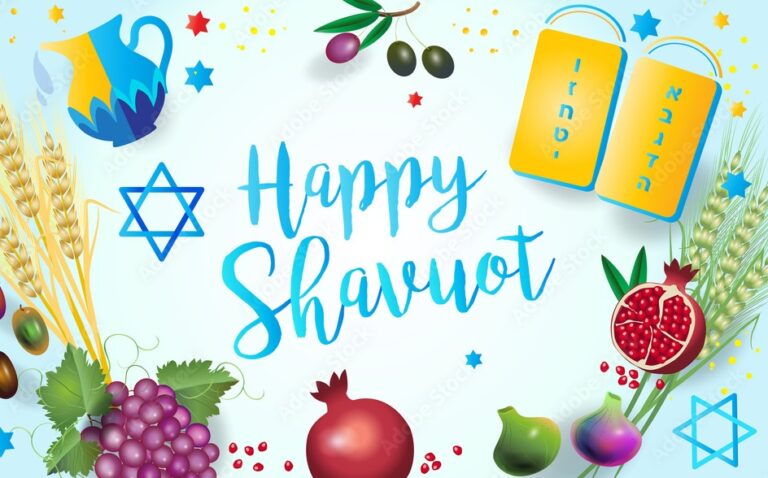
The festival of Shavuot (or Shavuos, in Ashkenazi usage; Shabhuʿoth in Classical and Mizrahi Hebrew Hebrew: שבועות, lit. “Weeks”) is a Jewish holiday that occurs on the sixth day of the Hebrew month of Sivan (late May or early June).
Shavuot commemorates the anniversary of the day G-d gave the Torah to the entire Israelite nation assembled at Mount Sinai, although the association between the giving of the Torah (Matan Torah) and Shavuot is not explicit in the Biblical text. The holiday is one of the Shalosh Regalim, the three Biblical pilgrimage festivals. It marks the conclusion of the Counting of the Omer.
Shavuot is not recognized as a public holiday in the US. However, many Jewish-linked entities may remain closed. The giving of the Torah was a far-reaching spiritual event—one that touched the essence of the Jewish soul for all times. Our sages have compared it to a wedding between G‑d and the Jewish people.
Shavuot also means “oaths,” for on this day G‑d swore eternal devotion to us, and we in turn pledged everlasting loyalty to Him.
In ancient times, two wheat loaves would be offered in the Holy Temple on Shavuot. It was also at this time that people would begin to bring bikkurim, their first and choicest fruits, to thank G‑d for Israel’s bounty.
How Is Shavuot Celebrated?
-
Women and girls light holiday candles to usher in the holiday, on both the first and second evenings of the holidays. Read the holiday candle-lighting procedure here.
-
It is customary to stay up all night learning Torah on the first night of Shavuot. Read how and why we stay up here.
-
All men, women and children should go to the synagogue to hear the reading of the Ten Commandments on the first day of Shavuot. Learn about the Ten Commandments here.
-
As on other holidays, special meals are eaten, and no “work” may be performed. More on how we “rest” on Jewish holidays.
-
It is customary to eat dairy foods on Shavuot. Menus range from traditional cheese blintzes to quiches, casseroles and more. Learn the reasons for eating dairy on Shavuot here.
-
On the second day of Shavuot, the Yizkor memorial service is recited. Brush up on Yizkor here.
-
Some communities read the Book of Ruth during morning services, as King David—whose passing occurred on this day—was a descendant of Ruth the Moabite. Read the Book of Ruth here.
-
Some have the custom to decorate their homes (and synagogues) with flowers and sweet-smelling plants in advance of Shavuot. Read 7 classic reasons for this custom here.
Learn how to apply their method to the challenges we face in the U.S. today. Discover “Interdependence”, what it is and how we get there. Be inspired by the wisdom our speakers share for hope today.
Dr. Susannah Heschel Scholar, author, and Dartmouth professor is the daughter of Rabbi Abraham Joshua Heschel, the 20th Century international leader, scholar, author and civil rights advocate.
Rabbi Capers Funnye Jr. is the spiritual leader of Chicago’s dynamic multi-cultural Conservative congregation Beth Shalom B’nai Zaken Ethiopian Hebrew Congregation and a noted expert on the transformational civil rights relationship between Dr. Martin Luther King and Rabbi Heschel.
Join us to be inspired by ideas for engaging meaningfully across borders of cultural difference in our families, neighborhoods, and communities across America today. Together we can marshal our passion to advance human rights, equity, and public safety right now, in the 21st century.
Tax deductible donations are accepted to benefit “CCFP Stop The Hate Programs” and Education. Sponsorships are available starting at $250. See www.connectingculturesforpeace.com/donate
For more information on this important event call: Jane West Walsh at 888-404-3175
More Information regarding Connecting Cultures for Peace:
Connecting Cultures for Peace, a non-profit 501(C)3 corporation was launched to address social justice and antisemitism. The grassroots organization is national, global in scope and creates partnerships between diverse cultures. The aim of Connecting Cultures for Peace is to establish a safe place where open dialog can begin a healing process and where relationships of trust and respect can be established. The overarching goal is to build community and communication where everyone can belong and succeed.
The President of the organization is Michele Norris (Community Leader and a Jew of Color). The Board includes VP Jane West Walsh (Jewish and Adult Educator), Amanda Strange, Treasurer, Michelle Princenthal, Director (Youth Educator), Cal Jackson, Director (DEI Practitioner), Charlotte Israel and Dr. Patricia Hauser (Pastors of Multicultural Non-denominational organizations), Iris Sandow (Advocate for the Disabled), Cheryl Stark (Community Leader), and Demetrius Vital (DEI Practitioner).
Website: www.Connectingculturesforpeace.org
# # # #
Biographies of Susannah Heschel and Capers C. Funnye, Jr.:
Susannah Heschel is the Eli M. Black Distinguished Professor and chair of the Jewish Studies Program at Dartmouth College. She is the author of several books on German Jewish history and has published over 100 scholarly articles. As the daughter of Rabbi Abraham Joshua Heschel, she has edited two volumes of his essays, supervised the translation of his work into languages around the world, and represents him at conferences and lectures, particularly at gatherings of Civil Rights leaders. She has received four honorary degrees and has held research grants from the Carnegie Foundation, the Ford Foundation, the National Humanities Center, the Guggenheim Foundation, and the Wissenschaftskolleg zu Berlin.
Rabbi Capers C. Funnye, Jr. is Chief Rabbi of the International Israelite Board of Rabbis. In addition, he is rabbi and spiritual leader of Beth Shalom B’nai Zaken Ethiopian Hebrew Congregation in Chicago and a long-time member of the Chicago Board of Rabbis. Rabbi Funnye is on the board of Kulanu, which supports isolated, emerging, and returning Jewish communities around the globe. Perhaps he is best known as the rabbi-cousin of Michelle Obama. Rabbi Funnye earned a Bachelor of Arts in Hebrew Literature and rabbinic ordination from the Israelite Board of Rabbis, Inc., Queens, NY. He also earned a Bachelor of Arts degree in Jewish Studies and Master of Science in Human Service Administration from Spertus Institute of Jewish Studies, Chicago, Illinois.